Case Study
Prim.io Shopify Public App
Prim.io is a Bulgarian ERP platform developed and operated by ANTIPODES OOD. It gives retailers, wholesalers and manufacturers a single system for inventory, warehousing, pricing, sales documents, logistics and financial records.
Prim.io serves companies that manage real stock across multiple warehouses and need their operational data — quantities, prices, shipments and documents — to stay accurate in one authoritative place. As a growing number of their clients began selling online, Prim.io needed their ERP to connect natively with e-commerce platforms, starting with Shopify.
The Project
The challenge
Merchants running their business in an ERP and their storefront on Shopify were maintaining two disconnected systems. Orders were re-entered by hand into the ERP, stock levels drifted apart until the store oversold, price changes had to be applied twice, and shipping data lived in a third place entirely. Every one of those steps was manual, slow and error-prone.
Prim.io needed a public Shopify application that would make the ERP and the storefront behave as one system — reliable enough to run unattended for many merchants at once, and simple enough for a shop owner to set up without a developer.
The solution
Commissioned by Gloross and built in collaboration with them, Prim.io ERP Integration is a public embedded Shopify app that keeps a merchant's Shopify store and their Prim.io ERP account continuously in sync — in both directions.
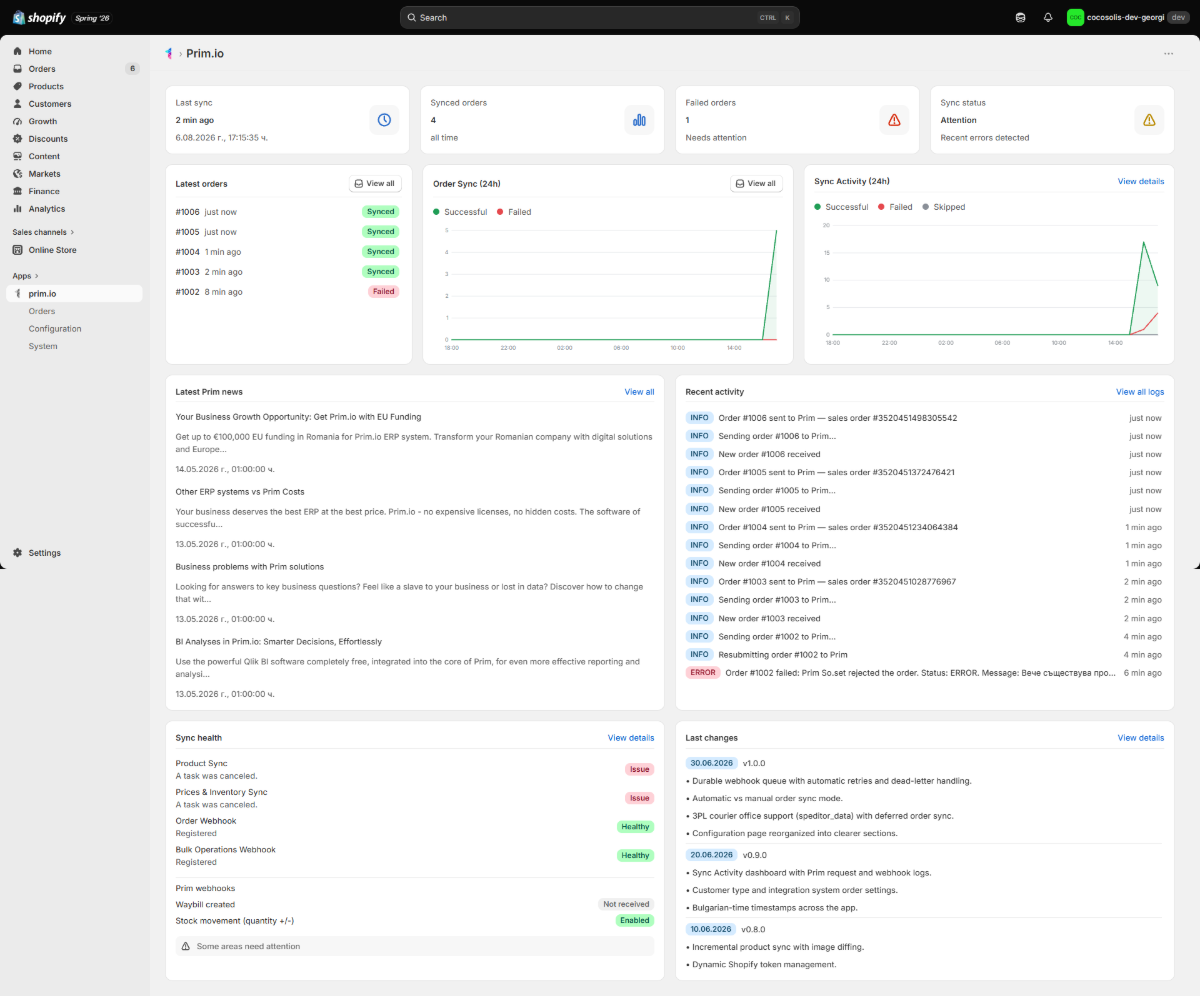
The app is fully self-service: a guided onboarding flow walks the merchant through connecting their ERP, choosing their operational defaults, and mapping their warehouses, price lists, payment methods and shipping carriers between the two systems. From that point on, everything runs in the background.
Key capabilities
- Real-time order sync — a Shopify order becomes a sale in the ERP within seconds, with the customer, items, payment type and delivery method translated into the merchant's own ERP codes.
- Inventory synchronization — stock levels update every minute, with optional instant push from the ERP; multiple ERP warehouses are consolidated into the correct Shopify locations.
- Price and product sync — price lists, titles, descriptions, weights, images and product status flow from the ERP into Shopify, with per-field control over what the ERP owns.
- Logistics and couriers — Shopify shipping methods map to ERP delivery codes, including third-party logistics and courier pickup offices, so the carrier and selected office travel with the order.
- Shipment tracking — when a waybill is issued in the ERP, the app creates the Shopify fulfillment with the tracking number and the customer is notified automatically.
- Multi-store workspaces — merchant groups can connect up to ten stores under a single organization.
- Full operational visibility — plain-language activity logs, a sync activity dashboard, and inspectable request payloads for fast support.
Engineering highlights
Reliability was the core requirement: a public app processes other companies' live orders, and a lost order is a lost sale. Inbound events are written to a durable queue and processed with automatic retries and exponential backoff, so nothing is dropped during a network failure or a deployment. Catalogue-wide operations use Shopify's bulk operations API to move thousands of products efficiently, while incremental syncs push only what actually changed.
The app authenticates with Shopify session tokens, stores credentials server-side, verifies every incoming webhook, and implements Shopify's mandatory privacy webhooks — including complete deletion of a store's data on uninstall. Billing is handled through Shopify with multiple subscription tiers, and the entire interface is localized in English, Bulgarian and Romanian.
Result
Prim.io merchants can now sell on Shopify without maintaining a second system by hand. Orders reach the warehouse automatically, stock stays accurate on both sides, and shipment tracking reaches the customer without anyone copying a number between two screens.
Technologies
 .NET 8
 C#
C# PostgreSQL
 React
React Node.js
 Shopify GraphQL API
 REST API
 Webhooks
 Nginx
Nginx Linux
Linux